A former employee has challenged a termination at your San Diego business. Now a demand letter, agency complaint, or lawsuit is on your desk. Backstrom Labor Law helps employers assess what happened, protect the existing record, and decide what needs attention first.
Request a Consultation
Send the basics and we'll reach out to schedule your consultation.
Confidential. Reviewed personally by Karin Backstrom.
A wrongful termination claim calls for an employer to identify the applicable deadline, preserve relevant records, control unnecessary communications, and determine exactly what the former employee alleges. Working with a wrongful termination defense attorney in San Diego from the start helps ensure those first decisions are made with a clear picture of what the claim requires.
For a family-run business in South County, a healthcare practice in central San Diego, or a growing North County company, management still has employees, customers, and operations to handle while the claim demands attention.
Start with five steps:
A demand letter, California Civil Rights Department complaint, EEOC charge, and civil lawsuit can follow different procedures and timelines.
Keep personnel documents, performance reviews, discipline, emails, texts, investigation materials, and communications surrounding the termination.
If your company carries employment practices liability insurance, check the policy and applicable notice requirements.
Consider getting legal guidance before responding substantively to the former employee or their attorney.
Limit unnecessary circulation of the allegations and do not assume that every internal discussion receives attorney-client privilege.
If your company receives a California civil summons and complaint, the summons generally directs the defendant to file a written response within 30 days after service. Other documents, including agency complaints and demand letters, can follow different timelines.
Before you reply to the former employee or their attorney, get a clear read on what arrived and what deadline applies. One direct conversation with Karin, no obligation to move forward.
Wrongful termination means a former employee claims the employer ended the employment relationship for a reason prohibited by law or in violation of another legally recognized restriction. A termination may feel unfair to an employee without meeting the legal requirements for a wrongful termination claim.
California generally follows an at-will employment rule. Employment without a specified term may ordinarily end at the will of either party, but that rule does not authorize termination for an unlawful reason.
At-will employment gives California employers substantial discretion to make legitimate employment decisions. It does not remove laws addressing discrimination, retaliation, whistleblower activity, protected leave, accommodation, contracts, or certain public-policy concerns.
That changes the defense question.
Counsel may need to examine why the decision occurred, when management began considering it, who participated, what each decision-maker knew, and what the company's records showed at the time.
California law also reaches many businesses that fall outside some federal discrimination statutes. For discrimination and retaliation, California's Fair Employment and Housing Act, commonly called FEHA, generally covers employers with five or more employees. Title VII generally covers private employers with 15 or more employees.
For San Diego's small and mid-sized businesses, that distinction can matter.
A former employee may use several legal theories to challenge one termination. The allegations can involve discrimination, retaliation, whistleblower activity, protected leave, public policy, or an employment agreement.
Each theory changes what facts deserve attention. Select a claim type to see how the defense analysis differs.
A former employee may allege that a protected characteristic influenced the termination decision.
For the employer, the analysis starts with the actual business reason. Was management responding to performance, attendance, misconduct, restructuring, loss of work, policy violations, or another legitimate factor?
Counsel can compare that reason against the chronology, documents, decision-maker communications, and treatment of employees in comparable situations.
California law also expressly recognizes discrimination based on a combination of two or more protected characteristics.
Timing can become a major issue when an employee complains shortly before termination.
The employee might allege retaliation after reporting discrimination or harassment, participating in an investigation, requesting an accommodation, raising wage concerns, or engaging in another form of legally protected conduct.
Timing alone does not decide the claim.
The record may show that performance or conduct concerns existed well before the complaint. In another case, close timing combined with changing explanations may require closer examination.
California whistleblower law protects certain employee disclosures about suspected legal violations and certain refusals to participate in unlawful conduct.
For the employer, two questions often deserve early attention:
The chronology matters when a termination follows closely after the reported concern.
A termination near medical leave, a disability accommodation request, pregnancy-related leave, or family leave may produce overlapping allegations.
The former employee might challenge the termination and also question how the company handled accommodation, the interactive process, leave, or return-to-work issues.
Protected leave does not automatically prevent an employer from making otherwise lawful employment decisions. It does make the reason, timing, documentation, and handling of the protected issue important to the analysis.
California recognizes claims alleging that an employer terminated someone in violation of a fundamental public policy reflected in law.
These allegations sometimes overlap with retaliation or whistleblower claims.
The employer needs to identify the specific policy the former employee relies on and compare that theory with the facts surrounding the decision.
An at-will statement does not answer every contract question.
Offer letters, employment agreements, executive agreements, compensation plans, handbook language, and communications with the employee may become relevant.
Layoffs can create a different issue. A former employee may argue that a restructuring or reduction in force masked discrimination or retaliation.
Selection criteria, business records, internal communications, and later hiring decisions may matter. Larger reductions can also raise separate federal or California WARN Act questions depending on the facts.
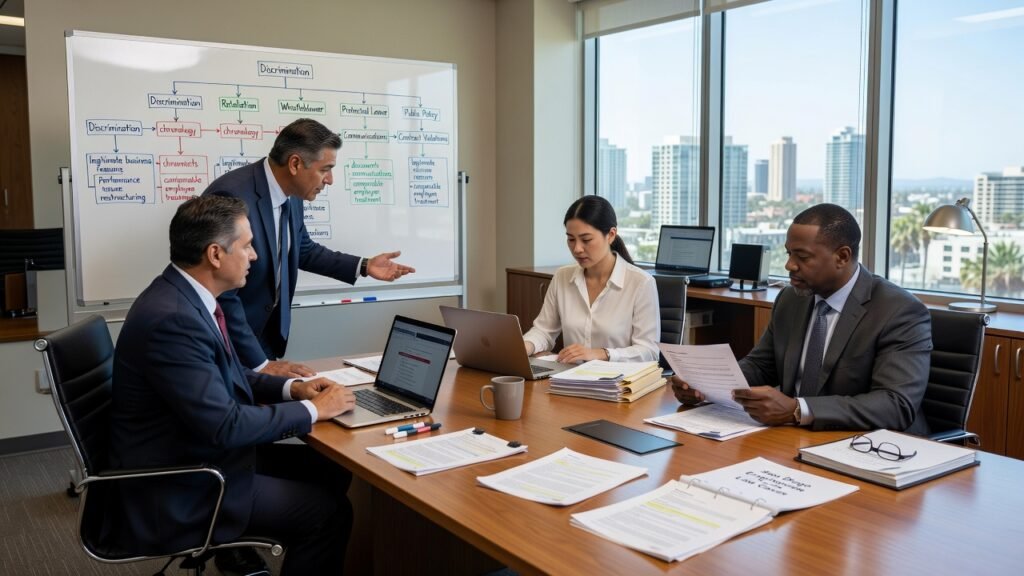
A defense analysis starts with a chronology that can be tested against the documents that already exist.
A wrongful termination defense often turns on the reason for the decision, the evidence that existed at the time, the chronology, the knowledge of the people involved, and whether the company applied its standards consistently. The complaint gives you the former employee's theory. The existing record helps test it.
Counsel may examine questions such as:
What reason did the company give for termination?
What documentation existed before the dispute?
Who made or influenced the decision?
What did those decision-makers know?
Had the employee recently made a complaint or engaged in protected conduct?
When did management first begin discussing termination?
Do earlier performance records support or conflict with the stated reason?
Did the company follow applicable policies?
How did the company handle comparable situations?
Did the explanation remain consistent?
One unfavorable fact does not answer every question.
Counsel needs to identify strong and weak facts early, determine what the evidence can support, and work with the record that actually exists.
For a business owner trying to keep crews working, patients scheduled, or customers served, that distinction matters. You need a clear read on the issues that affect the next decision.
A useful defense analysis starts with a chronology that can be tested against documents, witnesses, and the business reason given at the time.
Wrongful termination disputes often become disagreements about motive. Records the company created before the dispute can help show what managers knew, discussed, and documented when they made the decision.
What It May Help Show
Performance reviews
The employee's documented performance history
Discipline records
Concerns raised before termination
What decision-makers knew and when
The standards that applied
What management reviewed before acting
How the company handled similar situations
The reason stated at the time
Who has direct knowledge of disputed events
Electronic communications can matter alongside formal HR records. Emails, texts, calendar entries, Teams messages, and other business communications may help establish when a concern first arose.
Once a dispute develops, preserve potentially relevant information rather than relying on ordinary deletion practices.
If the personnel file is thin, managers communicated informally, or the termination memo does not tell the whole story, bring the available record as it exists. Karin can review the chronology, identify gaps, and explain which facts deserve closer attention.
This is often the question an owner does not want to ask:
"What if we handled part of this badly?"
Maybe a supervisor never issued the final warning. Maybe a performance review sounds more positive than management remembers. Maybe HR skipped an internal step. Maybe the company had a legitimate business reason but documented it poorly.
Do not try to rewrite the historical record. Other existing evidence may help reconstruct what happened:
Earlier emails
Attendance or scheduling data
Customer complaints
Coaching notes
Investigation materials
Business records
Manager communications
Witness information
Inconsistencies also need attention. If two managers remember the reason differently, or an internal message conflicts with the termination document, counsel needs to understand that issue before the company responds.
Bring the situation as it is. The analysis has to account for the facts that exist, including the ones management would handle differently in hindsight.
Exposure depends on the causes of action, employee's compensation, alleged harm, evidence, available defenses, and forum. Depending on the claim, available remedies may include back pay, future lost earnings, emotional-distress damages, attorney's fees and costs, or punitive damages when the governing law and facts support them.
A demand letter does not establish the value of a case.
The employer needs to compare the allegations against the evidence, applicable law, insurance issues, and cost of defending the matter before choosing a strategy.
Operational cost matters too. Document collection, depositions, discovery, and management involvement can pull owners, HR personnel, and supervisors away from the business.
A San Diego wrongful termination dispute can begin with a demand letter, administrative complaint, or lawsuit. The forum affects the response process, deadlines, information requests, and litigation path.
Wrongful termination lawsuits based on California law may proceed through San Diego Superior Court. Employers facing an active lawsuit should also understand what employment litigation defense process requires from the initial response through discovery, depositions, and potential trial.
Federal claims or another basis for federal jurisdiction can place an employment case in the U.S. District Court for the Southern District of California, which covers San Diego and Imperial counties. Federal Rule of Civil Procedure 12 generally gives a defendant 21 days after service of the summons and complaint to serve an answer, subject to exceptions that can change the timing.
A discrimination or retaliation matter may involve the California Civil Rights Department, or CRD, formerly known as DFEH. CRD can request an employer's response, supporting documents, and witness information while it investigates an accepted complaint. The employer should follow the response date in the letter accompanying the complaint rather than applying a court deadline to an administrative matter.
Federal discrimination and retaliation charges may involve the Equal Employment Opportunity Commission, which maintains a San Diego Local Office. An EEOC matter may call for factual investigation, preservation of records, supporting documents, and an employer response to the charge.
The forum changes the procedure. The company's employment record remains central.
The first legal review should turn documents and competing accounts into a clearer picture of what requires attention.
Depending on the matter, Karin may:
Identify the claims and applicable deadlines.
Reconstruct the termination chronology.
Review the documents and witness information available.
Assess the legal and factual issues.
Discuss response and defense options.
Address related workplace decisions while the dispute remains active.
The early review should help management understand what matters now, what information remains missing, and what the next stage may require.
If you have dealt with larger firms before, you may be wondering whether the attorney you meet initially will remain involved after you hire the firm. At Backstrom Labor Law, Karin handles employer matters personally. You work directly with the attorney responsible for assessing the claim and handling the legal work.
An active claim can make management hesitant about disciplining or terminating anyone else. Freezing every difficult personnel decision can create its own operational problems. Before another higher-risk termination and after reviewing what California law requires at each stage of the termination process an employer may want to examine:
Recent complaints or protected activity
Leave or accommodation issues
The stated reason for the decision
Supporting documentation
Treatment of comparable employees
Manager communications
Applicable policies or agreements
The same timing, documentation, and communication issues that receive scrutiny after a termination can often receive attention before the next one.
When your company faces a wrongful termination claim, you need to know who will handle the matter, which side of employment law that attorney represents, and whether the advice will help management make an actual business decision. Karin Backstrom’s professional background including her years at Littler Mendelson and Sheppard Mullin and her focus on employer-side employment law is what distinguishes the firm’s approach.
From its Old Town San Diego office, Backstrom Labor Law represents employers throughout San Diego County and across California.
Karin personally handles engagements rather than routinely handing the matter to a junior associate after the initial consultation.
Backstrom limits its employment and labor practice to representing employers. The firm does not represent employees bringing workplace claims.
Karin brings more than two decades of employer-side practice to termination, retaliation, discrimination, leave, workplace investigations, and litigation matters.
That volume gives Karin substantial pattern recognition when a matter turns on chronology, documentation gaps, conflicting explanations, witness accounts, or the relationship between an HR decision and later litigation.
Karin previously practiced at Littler Mendelson and Sheppard Mullin. Backstrom combines that employer-defense background with direct attorney involvement.
The attorney reviewing why a termination became a claim can also help management examine the next difficult employment decision before another dispute develops. Karin's work as an HRCI course instructor also gives HR professionals a relevant point of connection when evaluating outside counsel.
Backstrom's approach is practical, identify what matters in the record, explain the options, and help the employer decide what to do next.
Karin is a talented and hard-working attorney who cares deeply for her clients. She is always there for us when we need her and she is fair with her rates. The partner we have received in her is invaluable - she helps support my staff in challenging situations and she keeps us compliant in the ever-changing CA laws. I am relieved of so much stress as a small business owner because of Karin at my side.
Karin provided clear, strategic advice that helped us navigate a complex employment matter with confidence. From the initial consultation through resolution, she was responsive, thorough, and focused on protecting our business interests. Her ability to explain legal risks in practical terms made it easier for our leadership team to make informed decisions. We appreciated her proactive approach and strong litigation experience, which ultimately positioned us for a successful outcome. We would not hesitate to work with her again.
Yes. California’s at-will rule does not prevent a former employee from alleging that the employer terminated them for a reason another law prohibits. The California Civil Rights Department which enforces FEHA identifies the protected characteristics that California employers cannot lawfully consider when making termination decisions.
The employer’s response depends on the legal theory and facts surrounding the decision, including timing, documentation, decision-maker knowledge, and the stated business reason.
Identify the service date and response requirement, preserve potentially relevant records, review applicable insurance notice provisions, and gather the documents surrounding the termination.
Consider having employment counsel review the complaint and existing record before the company sends a substantive response.
A California civil summons generally directs a defendant to respond within 30 days after service. Federal Rule 12 generally uses a 21-day answer period after service of the summons and complaint, although exceptions can alter that timing.
Demand letters, CRD complaints, EEOC charges, and other proceedings follow different requirements. Use the actual document and forum to determine the applicable deadline.
Relevant records may include performance reviews, disciplinary documents, attendance records, policies, investigation materials, emails, texts, termination documents, compensation records, and communications among decision-makers.
The claim determines which records deserve the most attention. A retaliation allegation, for example, may place particular focus on chronology and decision-maker knowledge.
A recent complaint can become part of a retaliation allegation, but timing does not decide the matter by itself.
Counsel can examine what the employee reported, whether the law protects that conduct, who knew about it, when management began considering termination, and what documentation existed before the complaint.
A complaint may name an owner, executive, supervisor, or manager along with the company. The complaint's caption alone does not establish personal liability.
Whether an individual faces a viable claim depends on the causes of action, allegations, and applicable law. Counsel should review the claims against each named person separately.
Poor documentation can make disputed facts harder to establish, but it does not automatically determine whether the termination violated the law.
Other existing evidence may help reconstruct what happened, including emails, attendance data, customer complaints, business records, manager communications, witnesses, and records showing when management began considering the decision.
Whether you believe the termination made business sense or you already know the file has problems, the next step is the same conversation. Bring what you have.